

ابحث عما تريد
Industrial RO Systems for High-TDS Borehole Water in East Africa
زمن:2026-09-18
Borehole water is an important water source for factories, farms, hotels, hospitals, construction camps and local water plants across East Africa. However, groundwater in parts of Kenya, Tanzania, Uganda, Ethiopia, Rwanda and neighboring regions may contain high levels of dissolved salts, hardness, fluoride, iron, manganese or silica.
When borehole water has a high total dissolved solids level, conventional sand filtration alone cannot make it suitable for industrial processes or drinking-water production. A properly designed industrial RO system for high-TDS borehole water can remove most dissolved salts and provide a stable supply of purified water.
Why Does Borehole Water in East Africa Have High TDS?
Groundwater absorbs minerals as it passes through underground rock and soil formations. In dry or semi-arid regions, limited rainfall and high evaporation can further concentrate dissolved salts.
Common causes of high-TDS borehole water include:
- • Mineral-rich geological formations
- • Deep groundwater sources
- • High evaporation rates
- • Seawater intrusion in coastal areas
- • Seasonal changes in groundwater levels
- • Mixing water from different wells
- • Agricultural or industrial contamination
TDS values can vary significantly between locations and seasons. A single handheld TDS reading is not sufficient for designing an industrial borehole-water treatment system.
Common Contaminants in Borehole Water
High TDS is only one part of the water-quality problem. A complete laboratory report may also show:
| Contaminant | Possible impact |
|---|---|
| Hardness | Scaling in RO membranes, boilers and pipelines |
| Iron | Staining, deposits and membrane fouling |
| Manganese | Dark deposits, taste and equipment fouling |
| Fluoride | Health concern when present above the applicable limit |
| Silica | Difficult-to-remove membrane scale |
| Chloride | Corrosion and salty taste |
| Sulfate | Scaling and undesirable taste |
| Nitrate | Drinking-water and agricultural concern |
| Turbidity | Cartridge-filter blockage and membrane fouling |
| Microorganisms | Biofouling and hygienic risks |
The correct process must be selected according to the complete water analysis rather than TDS alone.
When Is Reverse Osmosis Required?
RO is usually considered when borehole water contains dissolved contaminants that cannot be removed by ordinary filtration.
An industrial RO system may be required when:
- • TDS is too high for the intended application
- • Water has a noticeable salty or mineral taste
- • Conductivity exceeds the production-water requirement
- • Hardness creates severe scaling
- • Chloride or sulfate levels are high
- • Fluoride or nitrate must be reduced
- • Boiler, food or manufacturing processes require low-TDS water
- • The customer needs consistent water quality throughout the year
Multimedia filters and activated carbon filters can remove suspended solids, color, odor and some organic contaminants, but they cannot effectively remove most dissolved salts.
Typical Treatment Process
A typical high-TDS borehole water RO system in East Africa may use the following process:
Borehole → Raw-Water Tank → Oxidation or Aeration → Iron and Manganese Removal → Multimedia Filter → Activated Carbon Filter → Softener or Antiscalant Dosing → Cartridge Filter → High-Pressure Pump → BWRO System → Disinfection → Product-Water Tank
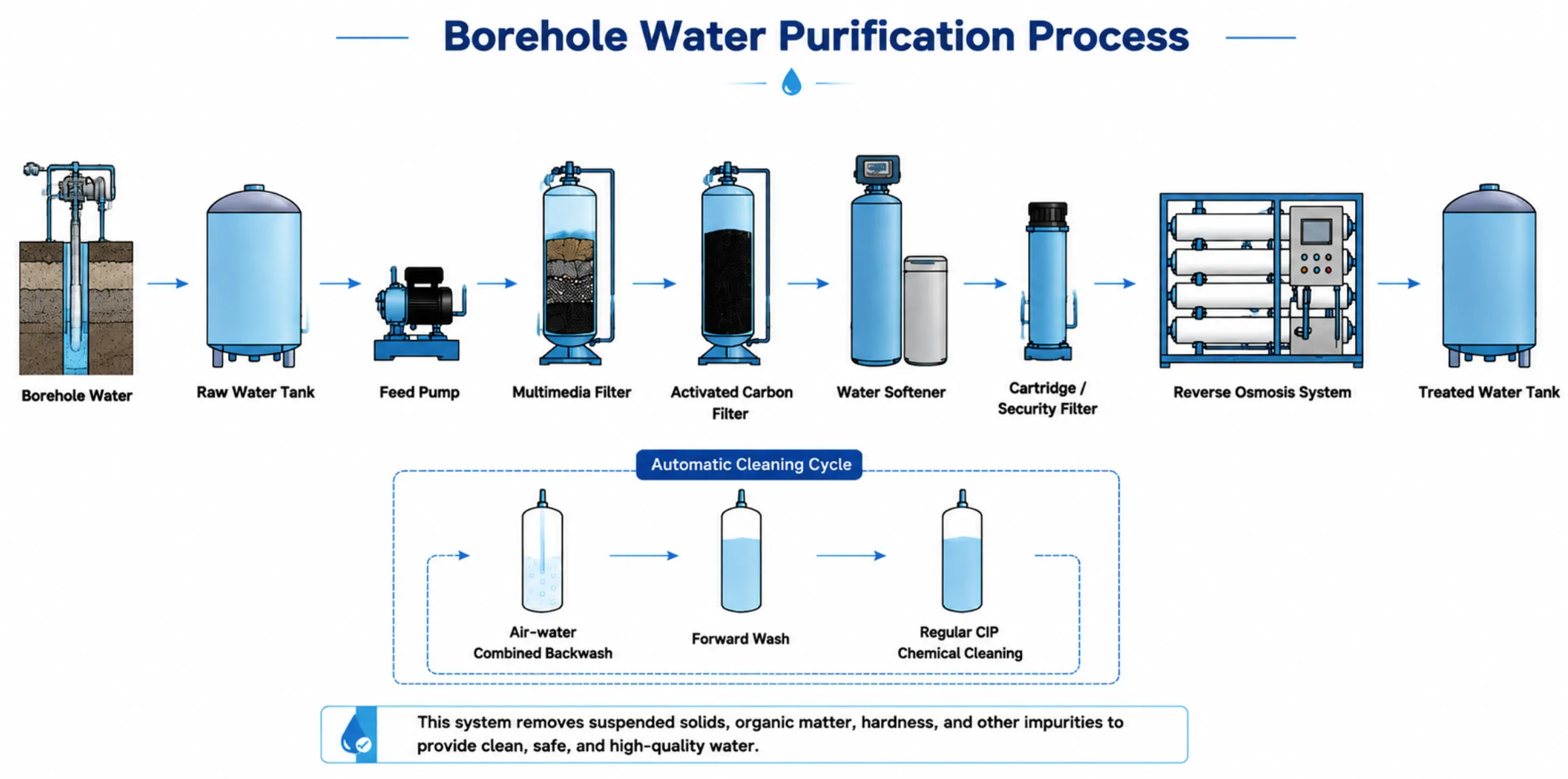
The actual configuration depends on the water-quality report.
Oxidation and Iron-Manganese Removal
If dissolved iron or manganese is present, oxidation may be required before filtration. This converts dissolved metals into particles that can be removed by suitable filter media.
Allowing excessive iron or manganese to reach the RO membranes may cause deposits, pressure loss and frequent cleaning.
Multimedia Filtration
A multimedia filter removes:
- • Suspended solids
- • Sediment
- • Rust particles
- • Oxidized iron and manganese
- • Part of the turbidity
Stable pretreatment helps protect the downstream cartridge filters and RO membranes.
Activated Carbon Filtration
Activated carbon may be used to reduce:
- • Chlorine
- • Odor
- • Color
- • Some organic compounds
If the raw borehole water does not contain chlorine or significant organic matter, engineers should evaluate whether activated carbon is necessary. Unnecessary carbon filtration may create additional microbial-management requirements.
Softener or Antiscalant Dosing
High-hardness groundwater creates a significant scaling risk.
A water softener replaces calcium and magnesium ions with sodium. It is often suitable for small and medium systems where regeneration salt is readily available.
Antiscalant dosing is more common in larger industrial RO systems. The chemical and dosage should be selected according to a scaling calculation based on the complete ionic analysis.
Cartridge Filtration
A cartridge filter, commonly installed before the high-pressure pump, captures remaining fine particles and protects the RO membrane feed channels.
Cartridge filtration cannot replace proper upstream pretreatment.
Brackish-Water Reverse Osmosis
BWRO membranes remove most dissolved salts from high-TDS borehole water. The system normally includes:
- • High-pressure pump
- • Industrial RO membranes
- • FRP pressure vessels
- • Feed, permeate and concentrate flowmeters
- • Pressure instruments
- • Conductivity monitoring
- • Automatic flushing
- • PLC control
- • Chemical dosing system
The membrane model, pressure and recovery must be determined by feedwater salinity and target permeate quality.
How Feedwater TDS Affects RO Design
As feedwater TDS increases, osmotic pressure also rises. The high-pressure pump must provide sufficient pressure to overcome osmotic pressure and maintain the required permeate flow.
Higher TDS may affect:
- • Pump pressure
- • Motor power
- • Membrane selection
- • Permeate conductivity
- • System recovery
- • Energy consumption
- • Concentrate-disposal volume
The system should be designed for the maximum expected TDS and minimum water temperature—not only the average laboratory value.
For variable groundwater conditions, a high-pressure pump equipped with a variable frequency drive can help stabilize pressure and permeate production.
BWRO or SWRO Membranes?
Most inland high-TDS borehole-water projects use brackish-water RO membranes. However, very saline coastal wells may require a higher-pressure membrane design.
BWRO Membranes
Suitable for many brackish groundwater applications, offering:
- • High salt rejection
- • Moderate operating pressure
- • Lower energy consumption than SWRO
- • Broad industrial application
SWRO Membranes
May be considered when the borehole is heavily affected by seawater intrusion or has very high salinity.
They require:
- • Higher operating pressure
- • Larger motor power
- • High-pressure-compatible vessels and piping
- • More careful energy evaluation
The decision should be based on membrane projection software and a complete ionic analysis.
Selecting the Correct RO Capacity
Required RO capacity should be calculated from actual daily water consumption.
A simplified calculation is:
Required RO Capacity = Daily Product-Water Demand ÷ Effective Operating Hours
For example, if a facility needs 100 m³ of purified water per day and plans to operate the RO system for 20 hours:
100 m³ ÷ 20 hours = 5 m³/h
A reasonable allowance may be added for production peaks, flushing, maintenance and future demand. Excessive oversizing should be avoided because it increases investment and may cause frequent starting and stopping.
Expected Recovery Rate
Recovery is the percentage of feedwater converted into product water.
The achievable recovery depends on:
- • Feedwater TDS
- • Hardness and alkalinity
- • Silica concentration
- • Sulfate levels
- • Temperature
- • Membrane arrangement
- • Antiscalant selection
- • Concentrate-disposal conditions
Many brackish-water RO systems operate within a moderate recovery range, but there is no single value suitable for every borehole.
Increasing recovery without a scaling calculation can cause membrane fouling and reduce service life.
Applications in East Africa
Industrial borehole-water RO systems can provide purified water for:
Food and Beverage Production
RO helps stabilize taste, conductivity and mineral content for beverage mixing, ingredient water and equipment cleaning.
Bottled-Water Plants
Borehole water can be treated through pretreatment, RO, disinfection and controlled remineralization before bottling, subject to local drinking-water regulations.
Hotels and Residential Developments
RO systems can reduce salinity and improve water quality for centralized building supply.
Agriculture and Livestock
Low-salinity water may be required for sensitive crops, hydroponics, dairy farms and livestock applications. Agricultural suitability should be evaluated using more than TDS alone.
Boiler Feedwater
Removing hardness and dissolved salts reduces scaling in boilers and heat-exchange equipment.
Manufacturing Plants
RO water is used in textiles, chemicals, cosmetics, electronics, metal processing and other industrial processes.
Remote Camps and Mining Sites
Skid-mounted or containerized RO systems can provide localized water production where municipal supplies are unavailable.
Design Considerations for East African Projects
Unstable Power Supply
The system may require:
- • Voltage and phase protection
- • Generator compatibility
- • Controlled restart after power failure
- • VFD pump control
- • Surge protection
Local voltage and frequency must be confirmed before manufacturing.
High Ambient Temperature
Equipment installed outdoors should be protected against heat and direct sunlight. Containerized systems may require insulation, ventilation or air conditioning.
Limited Operator Experience
Automatic PLC control, clear alarms and simple operating procedures can reduce human error. Operator training and remote technical support should be included when necessary.
Spare-Part Availability
Consumables and critical spare parts should be planned in advance, including:
- • Cartridge filters
- • Dosing-pump parts
- • Pressure gauges
- • Conductivity probes
- • Pump seals
- • RO membrane elements
Concentrate Disposal
RO concentrate contains the salts rejected from the feedwater. Disposal options depend on local regulations, soil conditions, site location and concentrate composition.
Possible solutions may include an approved discharge point, evaporation pond or further recovery treatment. Concentrate should not be discharged without evaluating its environmental impact.
Information Required for a Quotation
To design an industrial RO system for high-TDS borehole water, provide:
- • Complete borehole-water analysis
- • Minimum and maximum TDS
- • Required product-water capacity
- • Daily operating hours
- • Treated-water application
- • Target water-quality standard
- • Local voltage and frequency
- • Installation location and available space
- • Ambient temperature
- • Preferred installation type: skid-mounted or containerized
- • Concentrate-disposal conditions
- • Whether on-site installation and commissioning are required
If a complete water report is unavailable, at least test TDS, conductivity, hardness, pH, alkalinity, chloride, sulfate, silica, iron, manganese, fluoride, nitrate and turbidity.
Frequently Asked Questions
Can Sand Filtration Remove High TDS?
No. Sand filtration removes suspended solids but does not significantly reduce dissolved salts. RO or another desalination process is required.
Can RO Remove Fluoride from Borehole Water?
RO can significantly reduce fluoride under suitable operating conditions. Final performance depends on membrane selection, feedwater chemistry and system design.
Is High-TDS Borehole Water Safe to Drink After RO?
RO can reduce dissolved salts and many other contaminants, but drinking-water safety depends on the complete treatment process, disinfection, storage, distribution and compliance with applicable local standards.
Does RO-Treated Water Need Remineralization?
For drinking-water applications, remineralization may be recommended to improve taste, stabilize pH and reduce the corrosiveness of very low-mineral water.
How Often Should RO Membranes Be Replaced?
Membrane life depends on pretreatment quality, operating conditions and maintenance. Membranes should be replaced based on normalized performance and product-water quality rather than age alone.
Can the System Operate Using Solar Power?
Yes, solar power can be considered, particularly for remote projects. The power system must be designed around the RO pump load, operating schedule and starting requirements.
Conclusion
High-TDS borehole water is common in many East African industrial and commercial projects. A reliable solution requires more than installing an RO membrane. Feedwater salinity, hardness, silica, iron, fluoride, temperature and seasonal variation must all be evaluated.
A properly designed system combines suitable pretreatment, correctly selected BWRO or SWRO membranes, an efficient high-pressure pump, automatic control and safe concentrate management.
Providing a complete water-quality report allows engineers to select the correct process, recovery rate and equipment capacity while controlling energy use and membrane fouling.
Borehole water is an important water source for factories, farms, hotels, hospitals, construction camps and local water plants across East Africa. However, groundwater in parts of Kenya, Tanzania, Uganda, Ethiopia, Rwanda and neighboring regions may contain high levels of dissolved salts, hardness, fluoride, iron, manganese or silica.
When borehole water has a high total dissolved solids level, conventional sand filtration alone cannot make it suitable for industrial processes or drinking-water production. A properly designed industrial RO system for high-TDS borehole water can remove most dissolved salts and provide a stable supply of purified water.
Why Does Borehole Water in East Africa Have High TDS?
Groundwater absorbs minerals as it passes through underground rock and soil formations. In dry or semi-arid regions, limited rainfall and high evaporation can further concentrate dissolved salts.
Common causes of high-TDS borehole water include:
- • Mineral-rich geological formations
- • Deep groundwater sources
- • High evaporation rates
- • Seawater intrusion in coastal areas
- • Seasonal changes in groundwater levels
- • Mixing water from different wells
- • Agricultural or industrial contamination
TDS values can vary significantly between locations and seasons. A single handheld TDS reading is not sufficient for designing an industrial borehole-water treatment system.
Common Contaminants in Borehole Water
High TDS is only one part of the water-quality problem. A complete laboratory report may also show:
| Contaminant | Possible impact |
|---|---|
| Hardness | Scaling in RO membranes, boilers and pipelines |
| Iron | Staining, deposits and membrane fouling |
| Manganese | Dark deposits, taste and equipment fouling |
| Fluoride | Health concern when present above the applicable limit |
| Silica | Difficult-to-remove membrane scale |
| Chloride | Corrosion and salty taste |
| Sulfate | Scaling and undesirable taste |
| Nitrate | Drinking-water and agricultural concern |
| Turbidity | Cartridge-filter blockage and membrane fouling |
| Microorganisms | Biofouling and hygienic risks |
The correct process must be selected according to the complete water analysis rather than TDS alone.
When Is Reverse Osmosis Required?
RO is usually considered when borehole water contains dissolved contaminants that cannot be removed by ordinary filtration.
An industrial RO system may be required when:
- • TDS is too high for the intended application
- • Water has a noticeable salty or mineral taste
- • Conductivity exceeds the production-water requirement
- • Hardness creates severe scaling
- • Chloride or sulfate levels are high
- • Fluoride or nitrate must be reduced
- • Boiler, food or manufacturing processes require low-TDS water
- • The customer needs consistent water quality throughout the year
Multimedia filters and activated carbon filters can remove suspended solids, color, odor and some organic contaminants, but they cannot effectively remove most dissolved salts.
Typical Treatment Process
A typical high-TDS borehole water RO system in East Africa may use the following process:
Borehole → Raw-Water Tank → Oxidation or Aeration → Iron and Manganese Removal → Multimedia Filter → Activated Carbon Filter → Softener or Antiscalant Dosing → Cartridge Filter → High-Pressure Pump → BWRO System → Disinfection → Product-Water Tank
The actual configuration depends on the water-quality report.
Oxidation and Iron-Manganese Removal
If dissolved iron or manganese is present, oxidation may be required before filtration. This converts dissolved metals into particles that can be removed by suitable filter media.
Allowing excessive iron or manganese to reach the RO membranes may cause deposits, pressure loss and frequent cleaning.
Multimedia Filtration
A multimedia filter removes:
- • Suspended solids
- • Sediment
- • Rust particles
- • Oxidized iron and manganese
- • Part of the turbidity
Stable pretreatment helps protect the downstream cartridge filters and RO membranes.
Activated Carbon Filtration
Activated carbon may be used to reduce:
- • Chlorine
- • Odor
- • Color
- • Some organic compounds
If the raw borehole water does not contain chlorine or significant organic matter, engineers should evaluate whether activated carbon is necessary. Unnecessary carbon filtration may create additional microbial-management requirements.
Softener or Antiscalant Dosing
High-hardness groundwater creates a significant scaling risk.
A water softener replaces calcium and magnesium ions with sodium. It is often suitable for small and medium systems where regeneration salt is readily available.
Antiscalant dosing is more common in larger industrial RO systems. The chemical and dosage should be selected according to a scaling calculation based on the complete ionic analysis.
Cartridge Filtration
A cartridge filter, commonly installed before the high-pressure pump, captures remaining fine particles and protects the RO membrane feed channels.
Cartridge filtration cannot replace proper upstream pretreatment.
Brackish-Water Reverse Osmosis
BWRO membranes remove most dissolved salts from high-TDS borehole water. The system normally includes:
- • High-pressure pump
- • Industrial RO membranes
- • FRP pressure vessels
- • Feed, permeate and concentrate flowmeters
- • Pressure instruments
- • Conductivity monitoring
- • Automatic flushing
- • PLC control
- • Chemical dosing system
The membrane model, pressure and recovery must be determined by feedwater salinity and target permeate quality.
How Feedwater TDS Affects RO Design
As feedwater TDS increases, osmotic pressure also rises. The high-pressure pump must provide sufficient pressure to overcome osmotic pressure and maintain the required permeate flow.
Higher TDS may affect:
- • Pump pressure
- • Motor power
- • Membrane selection
- • Permeate conductivity
- • System recovery
- • Energy consumption
- • Concentrate-disposal volume
The system should be designed for the maximum expected TDS and minimum water temperature—not only the average laboratory value.
For variable groundwater conditions, a high-pressure pump equipped with a variable frequency drive can help stabilize pressure and permeate production.
BWRO or SWRO Membranes?
Most inland high-TDS borehole-water projects use brackish-water RO membranes. However, very saline coastal wells may require a higher-pressure membrane design.
BWRO Membranes
Suitable for many brackish groundwater applications, offering:
- • High salt rejection
- • Moderate operating pressure
- • Lower energy consumption than SWRO
- • Broad industrial application
SWRO Membranes
May be considered when the borehole is heavily affected by seawater intrusion or has very high salinity.
They require:
- • Higher operating pressure
- • Larger motor power
- • High-pressure-compatible vessels and piping
- • More careful energy evaluation
The decision should be based on membrane projection software and a complete ionic analysis.
Selecting the Correct RO Capacity
Required RO capacity should be calculated from actual daily water consumption.
A simplified calculation is:
Required RO Capacity = Daily Product-Water Demand ÷ Effective Operating Hours
For example, if a facility needs 100 m³ of purified water per day and plans to operate the RO system for 20 hours:
100 m³ ÷ 20 hours = 5 m³/h
A reasonable allowance may be added for production peaks, flushing, maintenance and future demand. Excessive oversizing should be avoided because it increases investment and may cause frequent starting and stopping.
Expected Recovery Rate
Recovery is the percentage of feedwater converted into product water.
The achievable recovery depends on:
- • Feedwater TDS
- • Hardness and alkalinity
- • Silica concentration
- • Sulfate levels
- • Temperature
- • Membrane arrangement
- • Antiscalant selection
- • Concentrate-disposal conditions
Many brackish-water RO systems operate within a moderate recovery range, but there is no single value suitable for every borehole.
Increasing recovery without a scaling calculation can cause membrane fouling and reduce service life.
Applications in East Africa
Industrial borehole-water RO systems can provide purified water for:
Food and Beverage Production
RO helps stabilize taste, conductivity and mineral content for beverage mixing, ingredient water and equipment cleaning.
Bottled-Water Plants
Borehole water can be treated through pretreatment, RO, disinfection and controlled remineralization before bottling, subject to local drinking-water regulations.
Hotels and Residential Developments
RO systems can reduce salinity and improve water quality for centralized building supply.
Agriculture and Livestock
Low-salinity water may be required for sensitive crops, hydroponics, dairy farms and livestock applications. Agricultural suitability should be evaluated using more than TDS alone.
Boiler Feedwater
Removing hardness and dissolved salts reduces scaling in boilers and heat-exchange equipment.
Manufacturing Plants
RO water is used in textiles, chemicals, cosmetics, electronics, metal processing and other industrial processes.
Remote Camps and Mining Sites
Skid-mounted or containerized RO systems can provide localized water production where municipal supplies are unavailable.
Design Considerations for East African Projects
Unstable Power Supply
The system may require:
- • Voltage and phase protection
- • Generator compatibility
- • Controlled restart after power failure
- • VFD pump control
- • Surge protection
Local voltage and frequency must be confirmed before manufacturing.
High Ambient Temperature
Equipment installed outdoors should be protected against heat and direct sunlight. Containerized systems may require insulation, ventilation or air conditioning.
Limited Operator Experience
Automatic PLC control, clear alarms and simple operating procedures can reduce human error. Operator training and remote technical support should be included when necessary.
Spare-Part Availability
Consumables and critical spare parts should be planned in advance, including:
- • Cartridge filters
- • Dosing-pump parts
- • Pressure gauges
- • Conductivity probes
- • Pump seals
- • RO membrane elements
Concentrate Disposal
RO concentrate contains the salts rejected from the feedwater. Disposal options depend on local regulations, soil conditions, site location and concentrate composition.
Possible solutions may include an approved discharge point, evaporation pond or further recovery treatment. Concentrate should not be discharged without evaluating its environmental impact.
Information Required for a Quotation
To design an industrial RO system for high-TDS borehole water, provide:
- • Complete borehole-water analysis
- • Minimum and maximum TDS
- • Required product-water capacity
- • Daily operating hours
- • Treated-water application
- • Target water-quality standard
- • Local voltage and frequency
- • Installation location and available space
- • Ambient temperature
- • Preferred installation type: skid-mounted or containerized
- • Concentrate-disposal conditions
- • Whether on-site installation and commissioning are required
If a complete water report is unavailable, at least test TDS, conductivity, hardness, pH, alkalinity, chloride, sulfate, silica, iron, manganese, fluoride, nitrate and turbidity.
Frequently Asked Questions
Can Sand Filtration Remove High TDS?
No. Sand filtration removes suspended solids but does not significantly reduce dissolved salts. RO or another desalination process is required.
Can RO Remove Fluoride from Borehole Water?
RO can significantly reduce fluoride under suitable operating conditions. Final performance depends on membrane selection, feedwater chemistry and system design.
Is High-TDS Borehole Water Safe to Drink After RO?
RO can reduce dissolved salts and many other contaminants, but drinking-water safety depends on the complete treatment process, disinfection, storage, distribution and compliance with applicable local standards.
Does RO-Treated Water Need Remineralization?
For drinking-water applications, remineralization may be recommended to improve taste, stabilize pH and reduce the corrosiveness of very low-mineral water.
How Often Should RO Membranes Be Replaced?
Membrane life depends on pretreatment quality, operating conditions and maintenance. Membranes should be replaced based on normalized performance and product-water quality rather than age alone.
Can the System Operate Using Solar Power?
Yes, solar power can be considered, particularly for remote projects. The power system must be designed around the RO pump load, operating schedule and starting requirements.
Conclusion
High-TDS borehole water is common in many East African industrial and commercial projects. A reliable solution requires more than installing an RO membrane. Feedwater salinity, hardness, silica, iron, fluoride, temperature and seasonal variation must all be evaluated.
A properly designed system combines suitable pretreatment, correctly selected BWRO or SWRO membranes, an efficient high-pressure pump, automatic control and safe concentrate management.
Providing a complete water-quality report allows engineers to select the correct process, recovery rate and equipment capacity while controlling energy use and membrane fouling.
سابق:لا مزيد من البيانات


حقوق الطبع والنشر © 2026 Zhongnuo Water Treatment Co., Ltd.